
What Is Granular Sulfur? Form, Particle Size and Product Selection
Granules, prills, pastilles and bentonite formulations may refer to different products. Learn how to compare composition, disintegration and application methods when selecting granular sulfur.
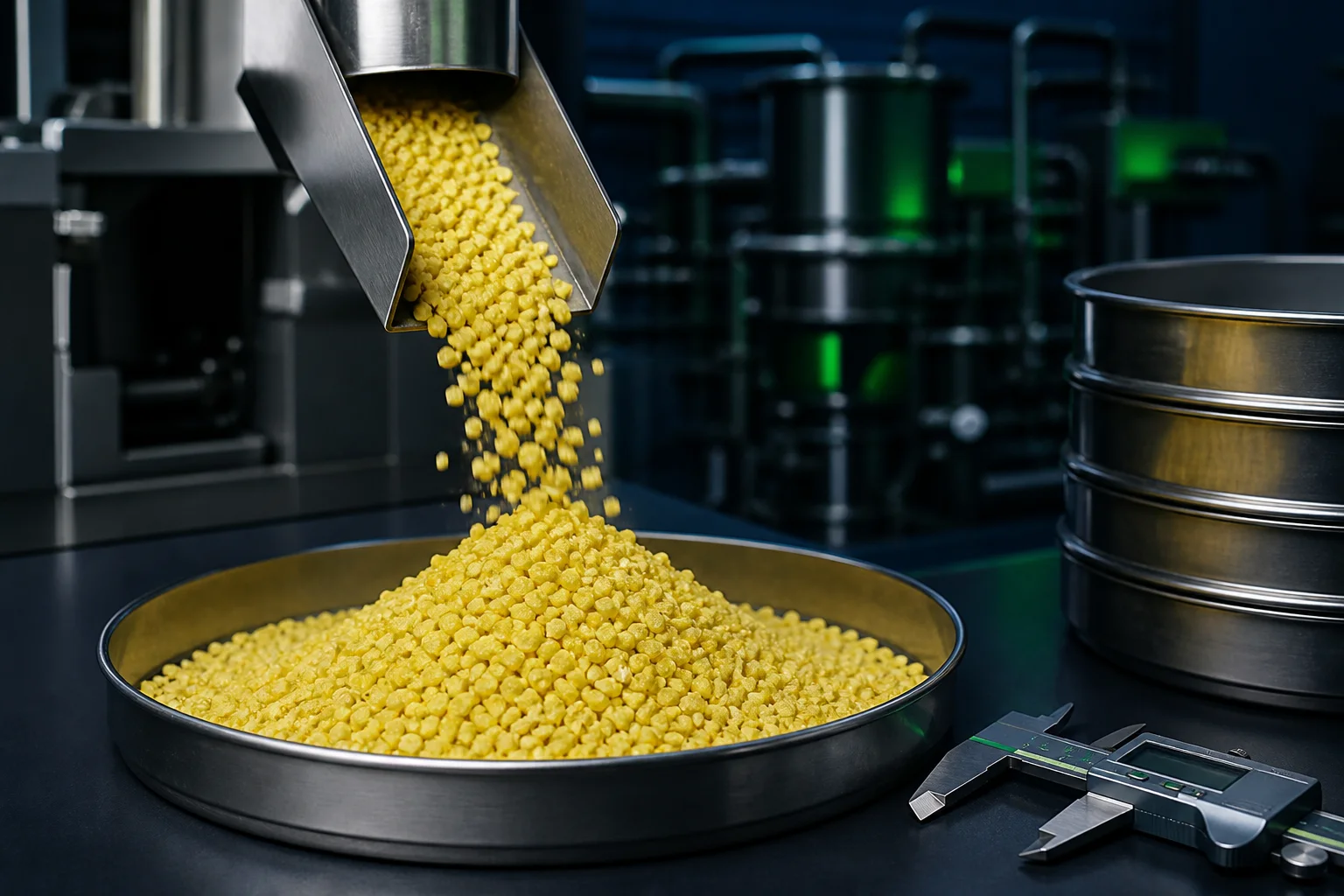
Granular sulfur is a general term for coarse commercial forms of elemental sulfur. However, products sold as “granular” are not all the same: refinery-derived prilled or pastilled elemental sulfur, granules prepared from ground raw material and agricultural products formulated with additional components such as bentonite can behave differently.
- Check the elemental sulfur percentage and any additional components.
- Granule diameter and the way a granule disperses or breaks down in soil are different properties.
- Agricultural, chemical and other industrial applications require different product specifications.
- Price comparisons should be made between products with the same composition, packaging and delivery terms.
Granules, prills, pastilles and chips
Terminology can vary between manufacturers and regions. Prills generally describe nearly round particles formed by cooling droplets of liquid sulfur; pastilles are flatter pieces produced by controlled solidification. “Chips” or “lump” may describe larger, irregular pieces. In agriculture, the term granule is also used for formulated products that combine sulfur with bentonite or other carriers.
A product’s intended use cannot therefore be determined from a photograph or particle shape alone. Look for elemental sulfur content, moisture, ash, additional components, particle size and dispersion or disintegration properties in the TDS.
How should granular sulfur be assessed for agriculture?
The underlying mechanism in soil pH management is the oxidation of elemental sulfur to sulfate by microorganisms. Surface area, soil contact and granule disintegration influence this process. A very coarse elemental sulfur particle that does not break down has less surface area than the same mass of fine material; formulated granules, however, may be designed to break into smaller particles when wet.
Neither blanket statement—“granular products are slow” or “granular products are always more practical”—is therefore reliable. Product design, soil conditions and application method should be examined together.
A guide to selecting the right granular product
| Check | Question to ask | Why does it matter? |
|---|---|---|
| Composition | What is the elemental S content, and what additional components are present? | Two products of the same weight can have different actual contents. |
| Particle size | How were the nominal range and tolerance measured? | It affects equipment compatibility and distribution. |
| Disintegration | How does the granule break down after contact with moisture? | It can affect the surface area in contact with soil. |
| Application | Will it be applied to soil or used through another system? | Off-label applications should be avoided. |
| Documentation | Are a current TDS, SDS and label available? | They establish the technical and safety scope. |
| Traceability | Can a batch number and CoA be provided? | They help verify the dispatched material. |
Can coarse elemental sulfur granules be applied to foliage?
Coarse granular raw materials are not designed for foliar application. Foliar products require a formulation that complies with applicable regulations, much more controlled particle characteristics, an appropriate dispersing or wetting system and clear label instructions. Using a granular product without grinding it, or outside its label instructions, cannot be considered safe.
How should granular sulfur prices be compared?
Older market commentary quickly becomes outdated. A sound comparison considers the quotation date, delivery terms, origin, elemental sulfur content, granule type, packaging, quantity, logistics and payment terms together. Looking only at the price per tonne risks treating different products as equivalent.
Application note: Agricultural application rates and timing should be determined according to soil analysis, crop, climate, product label and advice from a qualified professional. This article does not recommend an application rate.
Köseoğlu Granular Sulfur
Visit the Granular Sulfur product page for current information on product form, packaging and technical documentation. Specify your application equipment and objective to request product-specific information.
Get technical guidance for your application.
Contact our team for product selection, technical documents, or a quote.