
What Is Sulfur? Properties, Production and Uses
Understand the distinction between sulfur and sulfide, and explore elemental sulfur’s main properties, modern sources and uses from agriculture to rubber manufacturing.
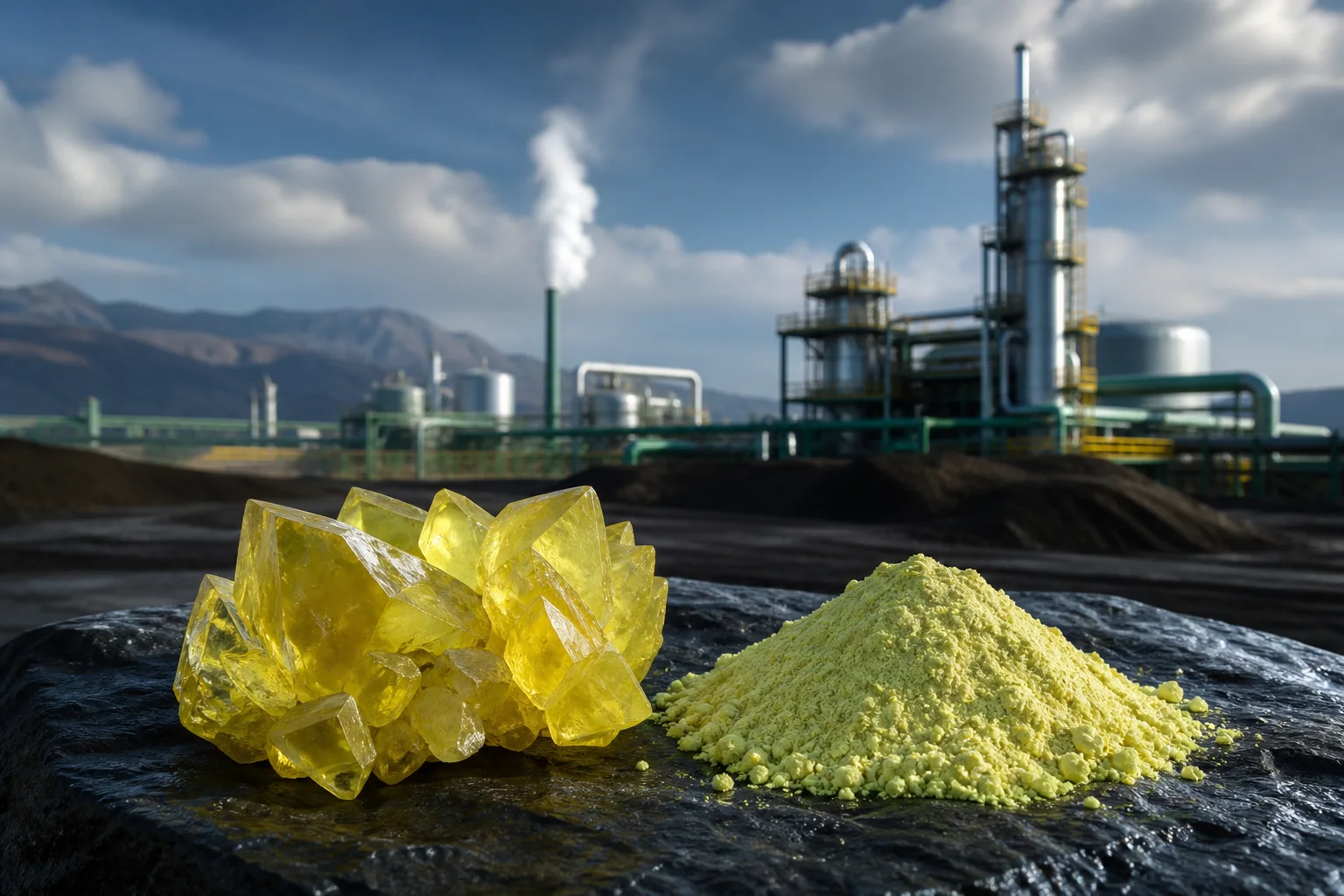
Sulfur is a chemical element with the symbol S and atomic number 16. In Turkish, the word “sülfür” is also often used to refer to elemental sulfur. “Sulfide,” however, describes certain classes of compounds formed by sulfur with other elements. Distinguishing these terms is the first step toward understanding product documentation and applications correctly.
- Elemental sulfur is a chemical element; sulfide is a class of compounds / ions.
- Its common appearance under ambient conditions is a yellow solid.
- It has low solubility in water and is processed into powder, micronized, granular or formulated products according to the application.
- Its largest use worldwide is in the sulfuric acid production chain, primarily for fertilizer production.
The difference between sulfur, “kükürt” and sulfide
“Sulfur” is the English name of the element; its Turkish equivalent is “kükürt.” “Sulfide,” or “sülfid” in Turkish, is the chemical term used for compounds formed by sulfur with a more electropositive element. Iron sulfide and zinc sulfide are examples. Describing an elemental sulfur product and sulfide compounds as the same substance is chemically incorrect.
Main properties of elemental sulfur
The NIST Chemistry WebBook lists sulfur with the formula S and CAS number 7704-34-9. Pure elemental sulfur is generally seen as a yellow solid. A commercial product’s appearance and flow behavior can vary with particle size, production method, purity, added process oil and storage conditions.
| Parameter | General information | Relevance to product selection |
|---|---|---|
| Chemical identity | Elemental sulfur, symbol S | The TDS and SDS should show the same CAS number / product description |
| Physical appearance | A yellow solid: powder, granules or another commercial form | Selected according to application equipment and process requirements |
| Water solubility | The elemental form has low solubility | Immediate dissolution should not be expected in agricultural use |
| Flammability / dust | Fine powder requires safe handling | Follow the SDS and ventilation and dust control instructions |
How is sulfur produced today?
While mining natural deposits was important in the past, much of today’s commercial sulfur is obtained by removing and recovering sulfur-containing components, such as hydrogen sulfide, during oil and natural gas processing. This reduces sulfur in fuels while providing recovered elemental sulfur as an industrial raw material.
The USGS monitors sulfur as an important industrial raw material and identifies sulfuric acid production as its principal use. Although sources and refining methods vary, the key concern for the end user is verifying the commercial product’s purity, form and particle characteristics through current technical documentation.
Main applications
Sulfuric acid and the chemical industry
Elemental sulfur is one of the main raw materials for sulfuric acid production. Sulfuric acid is used in phosphate fertilizers, mineral processing and many chemical processes.
Agriculture and soil management
Under suitable conditions, microorganisms can oxidize elemental sulfur to sulfate. This process is linked both to the sulfur cycle in plant nutrition and to pH management in some alkaline soils. Product selection and application rates must be based on soil analysis and the product label.
The rubber industry
Sulfur is used as a vulcanizing agent in many rubber compounds. Micronized and process-oil-treated grades are evaluated according to process requirements such as dispersion, feeding and dust control.
Other industrial applications
Sulfur derivatives are used in paper manufacturing, metallurgy, chemical synthesis and various specialized processes. Each application has different purity and physical-form requirements.
Are powder, granular and liquid products the same?
No. “Powder” and “granular” describe physical form, while “liquid sulfur” often refers to a commercial product in which elemental sulfur is suspended in a carrier or otherwise formulated. Content percentages, additional components and instructions vary by product. Equivalence cannot therefore be assumed from the product name alone.
Safety note: Safety requirements for fine sulfur powder and industrial processes, including fire and dust risks, should be managed according to the current SDS. Storage, transport and personal protective equipment instructions are specific to the product and facility.
The Köseoğlu Akkükürt product portfolio
Explore agricultural products under Agricultural Solutions and industrial products under Industrial Solutions. Share your requirements for product identity, purity, fineness and packaging to request technical information and a quotation.
Get technical guidance for your application.
Contact our team for product selection, technical documents, or a quote.