
What Is Micronized Sulfur? Understanding Particle Size and Mesh
Micronized sulfur, mesh rating and particle size distribution are different concepts. Explore the key steps for comparing fineness information in technical data sheets.
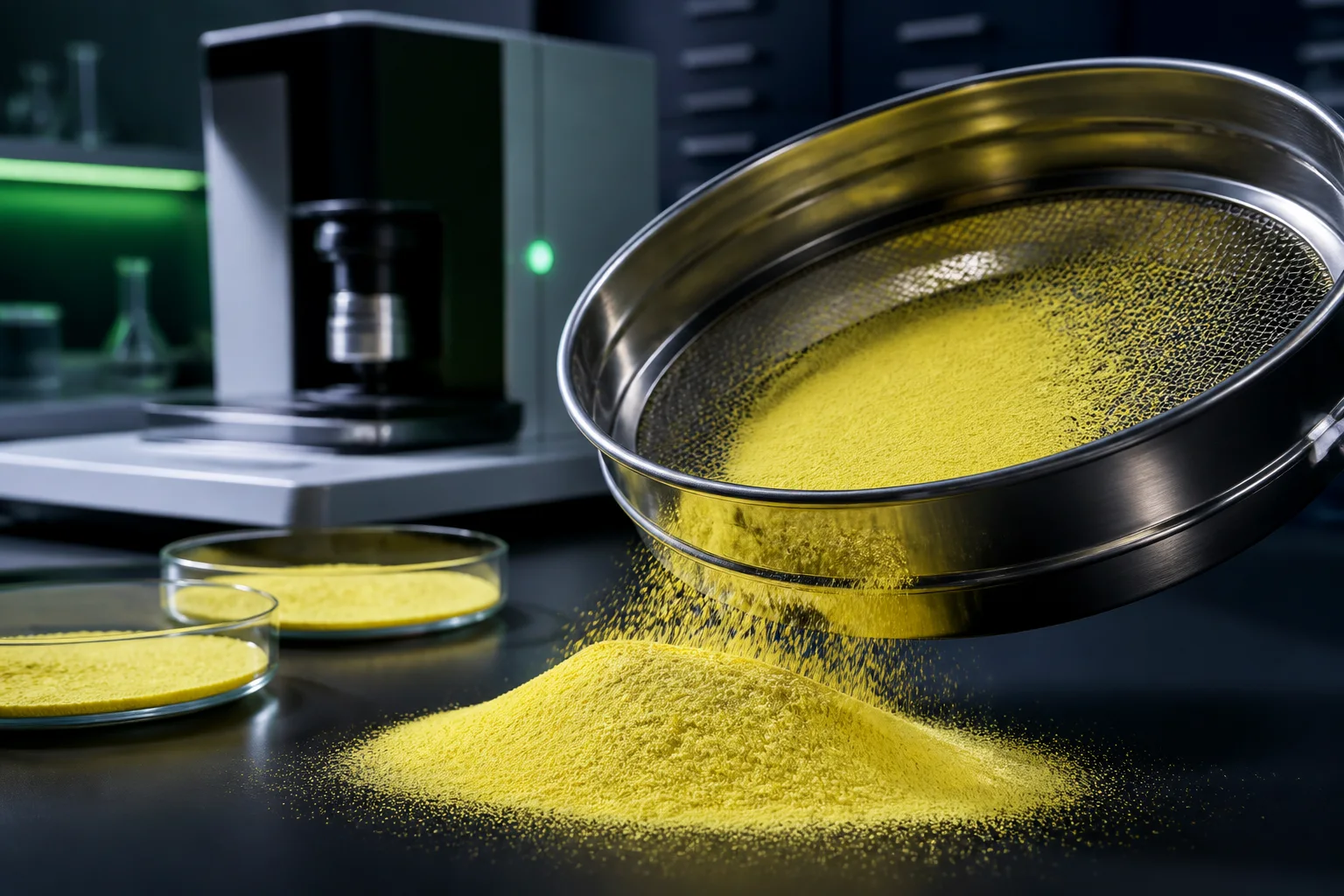
Micronized sulfur is elemental sulfur processed into a finer particle structure through controlled grinding and classification. Comparing products solely by asking “What mesh is it?” is often insufficient. Sieve standard, measurement method, particle size distribution, purity, surface treatment and the intended process should all be considered together.
- Micron is a unit of length.
- Mesh describes the openings or density of a particular sieve system; without a specified standard, it is not an exact particle diameter.
- Particle size distribution shows that a product does not consist entirely of particles of one size.
- The same fineness description is assessed against different performance requirements in agriculture and rubber processing.
What does “micronized” mean?
Micronization reduces a coarse raw material to a finer size range using suitable milling and separation systems. The aim is not simply to reduce the average particle size, but to achieve a repeatable distribution, a low risk of foreign matter and flow behavior suited to the process.
Smaller particles can increase the total surface area. In agriculture, this can affect the surface available for oxidation; in rubber, distribution and dispersion within the compound and interaction with the vulcanization system become important. Very fine powder, however, may require different controls for dust generation, agglomeration, handling and workplace safety.
The difference between mesh and micron
Mesh is a classification term associated with the number of openings per linear unit of a sieve. However, the actual opening for a given mesh rating can vary with wire diameter and the standard used. Rather than relying on context-free conversions such as “325 mesh is exactly this many microns,” look for the sieve standard and test method in the data sheet.
| Term | What does it describe? | What to check |
|---|---|---|
| Mesh | A designation related to sieve class / sieve opening | The standard used and the percentage passing or retained |
| Micron (µm) | A unit of length used to express particle diameter | The measuring instrument and distribution value |
| D50 | The median diameter below which half of the distribution falls | Remember that it does not show the upper end on its own |
| D90 | The diameter below which approximately 90% of the particles fall | Useful for understanding the coarse-particle tail |
| Percentage passing a sieve | The proportion of product passing through a specified opening | The test sieve, duration and sampling method |
How should technical data sheets be compared?
- Match the product identity: the product type and variant must match, as well as the trade name.
- Distinguish purity from composition: do not confuse elemental sulfur content with components such as process oil or a carrier.
- Ask about the fineness test: check which method was used to measure mesh, micron or laser diffraction data.
- Look at the distribution, not a single value: an average alone may not explain the coarse-particle fraction or agglomeration.
- Verify against batch documentation: a general TDS specification is not the same as the certificate of analysis for the dispatched batch.
Can the same micronized product be used in agriculture and industry?
Not always. For agricultural products, label scope, application method and regulatory compliance are central considerations. Rubber manufacturing may involve different technical parameters, such as vulcanization behavior, dispersion, ash, acidity, oil content and impurity profile. ASTM D4528 provides a framework for the classification and quality requirements of sulfur used in rubber compounds. ASTM D4573 covers the measurement of hydrocarbon oil added to sulfur for dust control.
Purchasing note: A higher mesh rating does not automatically make a product “better.” The right product meets the process requirements and is supported by current technical documentation.
Fineness options in Köseoğlu products
Elemental Micronized Sulfur Powder for agriculture and the ACY Extra Micronized Sulfur family for industry address different requirements. When selecting a variant, request the current TDS, SDS and, where needed, a batch certificate of analysis.
Get technical guidance for your application.
Contact our team for product selection, technical documents, or a quote.