
The Role of Sulfur in Rubber Vulcanization
Explore how sulfur contributes to crosslink formation in rubber compounds and why product grade and oil-treated variants must be validated against process data.
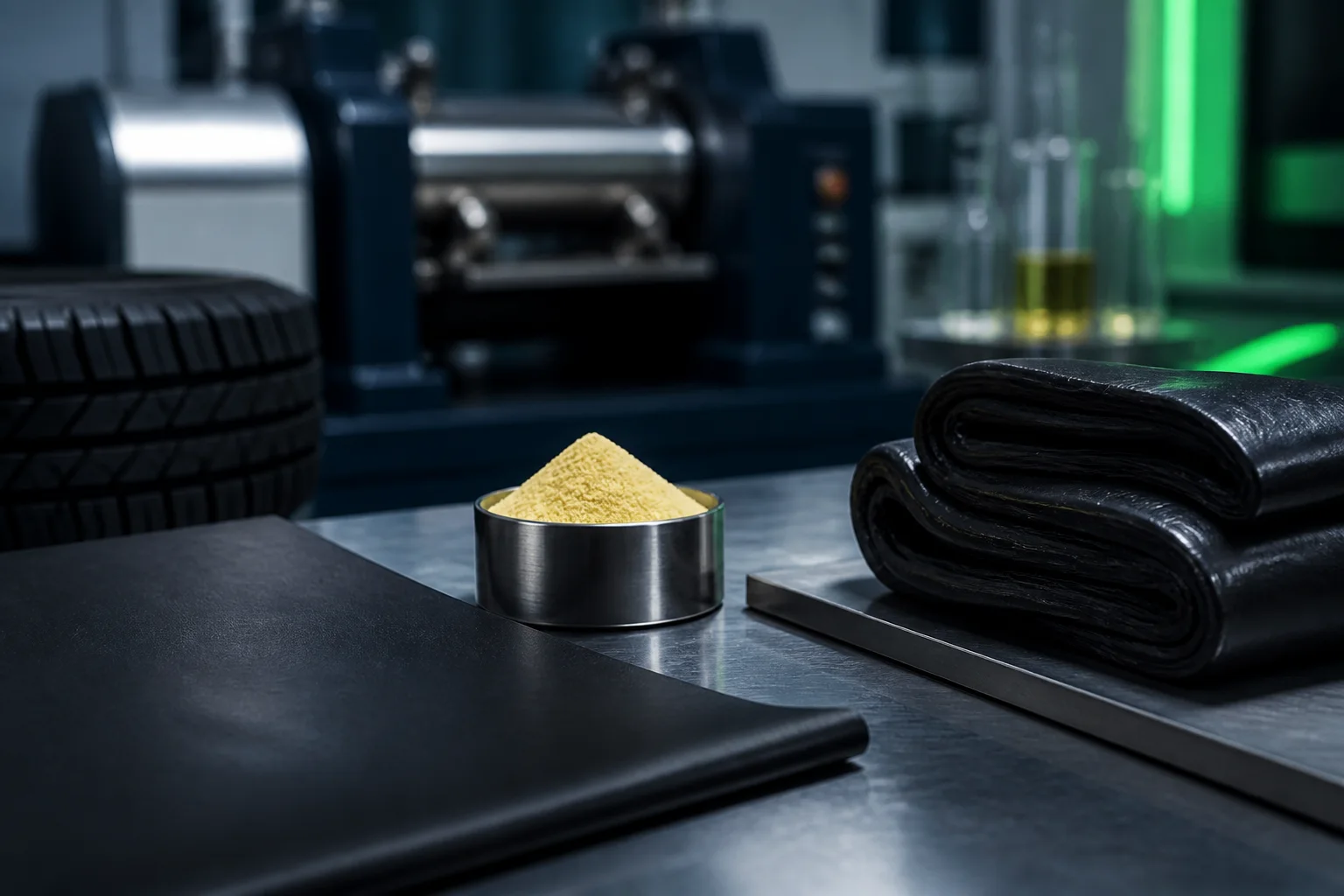
Sulfur is a key component of the vulcanization system in many rubber formulations. Together with heat, accelerators and other formulation components, it contributes to the formation of crosslinks between polymer chains. This transformation improves the raw rubber compound’s properties, including strength, elongation, modulus and hardness.
- Sulfur is assessed as part of the complete formulation, not in isolation.
- Purity, particle size distribution, dispersion and oil content can affect process repeatability.
- Oil-treated sulfur grades may be selected for dust control and handling behavior.
- The final dosage and curing system should be determined only by a qualified rubber formulation specialist.
Why is vulcanization necessary?
Although raw rubber can be processed, it does not by itself provide the stability required of a finished product under temperature changes, permanent deformation and mechanical loads. Vulcanization creates a controlled network between polymer chains, improving elastic recovery and strength.
In sulfur curing systems, crosslink density and structure are influenced by many variables, including the sulfur-to-accelerator ratio, curing temperature, time and activator system. Reliable process optimization therefore cannot be achieved by changing the sulfur content alone.
Which properties does sulfur help develop?
ASTM D4528 identifies sulfur as a principal vulcanizing agent for rubber and states that appropriate vulcanization improves properties such as tensile strength, elongation, modulus and hardness. Actual performance depends on the full combination of elastomer type, filler, oil, accelerator, antioxidant and processing conditions.
| Control parameter | Relationship to the process | Supporting documentation |
|---|---|---|
| Sulfur purity | Formulation consistency and control of unwanted components | TDS / batch certificate of analysis |
| Particle size | Distribution and dispersion behavior in the compound | Fineness result with the test method specified |
| Process oil | May alter dust generation and handling behavior | Oil content specification / ASTM D4573 |
| Ash and impurities | Can be monitored for product quality and process stability | TDS / CoA |
| Packaging and storage | Control of moisture, contamination and agglomeration risks | SDS, label and storage instructions |
What does sulfur with process oil mean?
Fine sulfur powder may generate dust during handling and feeding. In certain industrial products, a controlled amount of hydrocarbon oil is used to support dust control and process handling characteristics. ASTM D4573 describes a test method for determining total hydrocarbon oil in oil-treated sulfur.
Descriptions such as “1% oil-treated” or “5% oil-treated” are more than trade names: they describe part of the product composition and should be accounted for in formulation calculations. The oil type and actual content must be verified against current technical documentation.
Checklist for selecting an industrial product
- Define the elastomer and finished product type.
- Specify the existing mixing, feeding and dust control conditions.
- Clarify the required purity, mesh / particle size distribution and oil variant.
- Compare the units and test methods in the TDS, SDS and batch certificate of analysis.
- Before full-scale production, validate the product through laboratory trials, a rheometer curve and final physical testing.
Technical scope: This content is not a formulation recipe. The curing system, usage level and process parameters should be determined by a rubber formulation specialist using the facility’s test results.
The ACY Extra Micronized Sulfur product family
Köseoğlu Akkükürt’s ACY Extra Micronized Sulfur page provides technical information on pure and process-oil-treated variants. Share your required mesh, oil content, packaging and intended process to request a technical quotation.
Get technical guidance for your application.
Contact our team for product selection, technical documents, or a quote.